New day. Wednesday 22nd August 1945
On our last full day in Jerusalem we went along to the Jewish Services Club immediately after breakfast. We had some time to wait which I spent in perusing the “propaganda” which decorated the office walls – the accounts of the various increases in Jewish settlements and the figures for increasing produce, the photographs of the sand hills near Jaffa half a century ago and of Tel Aviv on the same spot today. The largest single item was Dr. W.C. Lowdermilk’s scheme for diverting the Jordan to make the Negev desert blossom and supply unlimited power to Palestine by allowing Mediterranean water to fall into the Dead Sea to compensate. The full JVA (Jordan Valley Authority) scheme, outlined from TVA is taken from Dr. Lowdermilk’s book “Palestine – Land of Promise”.
Punctual to the minute a short, cheerful looking Jew jumped up from his desk, called our names, and shepherded us out of the office. On the way across the street to the bus station he told us he was an Irishman from Liverpool and that his name was Cohen. The Egged bus station is always very busy, when we arrived it seemed to be even busier than usual and there were queues everywhere. “Just wait here a moment and I’ll fix that” said Mr. Cohen as he disappeared into the office. When he came back he led us over to the Haifa bus stop. The bus was in and several burly Jews were hurling great suitcases, boxes and bags of every sort on to the roof. Mr. Cohen explained that normally the Haifa bus carries only seated passengers going through to Haifa, but, to save waiting, we could travel by it if we did not mind standing. In no time we were away, far quicker than if we had waited for a seat.
The difference between our treatment by the Jewish bus company and by the Arab Company impressed itself upon my mind. Both were equally courteous and eager to help us. But when we wanted to get on the Arab bus to Nazareth the bus people had to spend about an hour persuading all the standing passengers to disembark (no mean feat, in Arabic!) and letting us in again one at a time, managing ultimately to find seats for Frank and myself after a tremendous amount of fuss and bother. Contrast the Jewish “breach” of a normal “no standing” rule, no trouble to anyone and we were away before the Arab could have even got his preliminary argument under way.
Some 14 kilometres down the winding Jaffa road, the bus pulled up and we got off. A tree-lined avenue led between the bare, rocky mountain side and a small copse on the right of the road. The sign-post pointed along it to Kiryat Anavim.
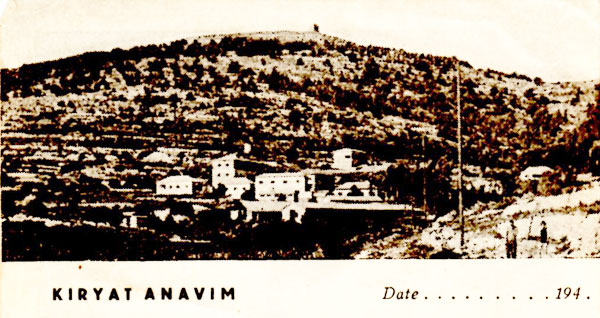
We followed along some little way and Mr. Cohen apologised for our having so far to walk and told us that he would stop and talk to us at intervals to make the walk less tiring. At the first halt he explained to us about the general system on which the collective settlements were run. He pointed out the trees under which we were sheltering from the heat of the sun. They were a pine whose home is in India. The little wood by the roadside was part of a general policy of re-afforestation to prevent soil erosion which is the nightmare of every Palestine farmer. The bare rocks and limestone screes were once all covered in soil and the land in those days must have been very fertile. But the trees were also in this particular position to act as a wind breaker for the vineyards which we were just approaching. Jewish scientists had made soil tests and carefully surveyed the climatic conditions and decided that this tree would be best suited to do this particular job just here, and so it was planted. Every Jewish settlement obtains free advice on any such problem from the scientists who work for the Jewish agency.
At the next halt we stopped under a little gnarled fig tree. He asked us to note the grapes growing from it. The vine was trailed up and around the trunk of the fig tree, but the result was very poor as both figs and grapes were below standard. But he told us that the Jews liked to plant vines in this manner for sentimental reasons – so that they could live “Every man under his vine and under his fig tree”.
The Jewish co-operative community, Mr. Cohen told us, is not confined to agricultural settlements. The same principle holds in, for example, Egged the bus company who brought us down. Everyone in Egged draws the same wage as everyone else, whether he be a mechanic, a cleaner, a bus driver, or general manager, and that wage is more properly a dividend, a proportion of the total profits. Each member of Egged receives free medical attention for self and family, and continues to draw wages when sick, and so on.
We were by this time well into the vineyards. The road was running alongside but some distance from the centre of a broad valley. The vineyards and other fruit orchards lay to the left of the little dusty road we were following, to the right lay bare and very rocky earth stretching up the mountainside. Behind us, further away than the main Jerusalem-Jaffa road, was another bare, rocky mountainside with a few trees dotted here and there. Ahead we could see the modern white stone settlement buildings and beyond a richly wooded hill – the trees are much thicker than when the photograph [?] was taken – which linked up with the hill the other side of our little valley, on which we could see the buildings of Abu Gosh. Abu Gosh has a Franciscan monastery, with a huge statue of Christ, which forms a prominent landmark, for it stands on the biggest ridge which the road climbs, on its steady downward run from Jerusalem to Lydda.
Forty years ago, Mr. Cohen said, Kiryath Anavim was like the hills to our right. We looked to the left and saw acres of vineyards. The vines just over the fence from where we stood were heavily laden with thick clusters of big purple dessert grapes, just ready for eating. The air was hot and drowsy, and across the little valley from where we stood a group of workers were busily picking grapes and a horse and cart made its way up towards the settlement.
This particular settlement, said Mr. Cohen, is in one sense a pioneer settlement, for it is the first settlement ever established by the Jews in the mountain country. Before work began, a band of volunteer pioneers, including several scientists, soil chemists, botanists, and a meteorologist, came up here and worked for a number of months, experimenting with various plants, for best results. For six months in the year there is a fair amount of rain. For the other six not only is there no rain, but also the sun is very hot. The hills are steep, so soil is rapidly washed away.
That is why the final recommendation was grape vines grown in terraces. The terraces are built up to follow the natural rocky contour line strata, the vines are a specially chosen type, and the results are very tempting on a hot day. The Jewish National Fund, which finances these settlements, laid it down as a condition that not more than one third of the land should be given up to any one produce, as an elementary precaution against “bad years”, diseases, or blights.
We arrived at the settlement proper, saw the old log huts where the first settlers lived, now used as a laundry, garage, and so on. The present settlers have modern square houses of white stone, standing among the trees at the head of the valley. The biggest building in the photo [?] is the only three storey building in the settlement, the office block. All the buying and selling is arranged here, this is the post office for the settlement, Mr Cohen got the enclosed leaflet from here, and here is the settlement’s police station.
We went into the garden, a beautiful small park, laid out with lawns and thick hedges in a terrace on the slope of the “Hill of the Five”. Mr. Cohen told us the story of the “Hill of the Five”, and quickly outlined the history of Jewish settlements in Palestine. The great difficulty is of course, Arab hostility. Some three or four hundred souls earn a living on and from this settlement. Yet the land that we passed on our right as we came up the road, which belongs to the Arabs, an area three times as great as the whole of Kiryath Anavim, supports only one family of ten souls, barely above starvation line, with the few sheep and goats they are able to keep. BUT the rich Arab landlords refuse to sell a single feddan of their land to any Jew. When they fall on hard times themselves, and are forced to sell, they will only part with land at fifty times the fair price. But the outlook is not hopeless. Around Kiryath Anavim the anti-Jewish feeling is not at all strong. The Jewish settlement has a doctor. The doctor, being a member of the settlement, gets no more money than the man who feeds the cows. But this doctor is a “panel” doctor, under the Palestine national health scheme. The extra money goes to the settlement funds, but the “panel” includes the Arabs from the nearby villages, and they do come in for treatment when ill, and the Jews in Kiryath Anavim do their best to make them welcome. Arabs always come to the wedding feast when any Jew on the settlement gets married, and Jews in turn, are invited, and go to the Arab wedding feasts. The majority of Jews in Palestine are opposed to any “terrorist” activities, do not support the “sterngang” and do their best, slowly and quietly, to befriend the Arabs in their immediate neighbourhood, Mr. Cohen said.
By this time a young lady had come up and introduced herself to Mr. Cohen in Hebrew. It appeared that she was a visitor to Jerusalem who had arrived at the settlement just after us, and been sent to join our party. She understood English fairly well, but was very self-conscious about speaking it. Mr. Cohen insisted on speaking to her in Hebrew, and apologised to us about speaking it, saying that since he left his own settlement near Gaza, to do this “war-work” in Jerusalem, he had had very little opportunity of speaking Hebrew, in which he had never been very fluent, and so he welcomed the chance of a little practice.
We asked various questions about the life of the community. The parents of children collect them from crèche, nursery school or school, all in the settlement, at 4.30 every evening, and parents and children are then completely free, do not have to worry about cooking meals, darning socks, or any household chores, until 8.30. There are, said Mr. Cohen, very few parents in English homes who can afford to spend four hours with their children every day, completely free to do whatever they like. At 8.30 the children go to bed. In some settlements the children sleep in communal dormitories, but in Kiryath Anavim, they sleep with their parents, at home. This is arranged by the vote of the whole settlement on the matter, as are all other questions of purely parochial importance.
We went to see the nursery school. The tots were just packing up to go for their lunch. They had been drawing various fruits, orange, lemon, grape, apple and so on, from cards, and they showed us their drawings, and Mr. Cohen interpreted for us. After three or four rather hectic minutes, we made a strategic withdrawal and Mr. Cohen took us into one of the classrooms in the school which the older children attend. They were on holiday at the time, were helping their parents in the vineyards. At the moment the settlement is sheltering a large proportion of refugee children from Europe, all of whom are adopted by some family on the settlement, and many of whom will stay on at Kiryath Anavim.
The system of education is based on the needs of the modern farmer. The youngsters start their education by learning what the different products of the land look like, and all about them. The same idea runs through the whole educational syllabus, and the class-room we were in was surrounded by specimens of the insects and pests which are found at Kiryath Anavim, so that the boys and girls may get to know which are harmful and which are useful, and be of real assistance, when, as at that moment, they get the chance to work with their elders on the land.
The school and the cookhouse, the offices, and the other community buildings stand together on the slope of the “Hill of the Five”, above the houses of the settlers. I mentioned that every settlement must have at least three different strings to its bow. The second in Kiryath Anavim, after grapes, is dairy farming. We crossed the road to the long cow sheds, arranged in accordance with modern scientific principles, decidedly un-picturesque, if remarkably clean. There is no grass at Kiryath Anavim, so the cows live either indoors or in small pens. Their fodder is brought up from the meadows, which the Kiryath Anavim community harvest and own, in the more fertile irrigated plain of Sharon. From 6 to 10 cuttings of grass are obtained every year and brought up to Kiryath Anavim. We saw the cows, we saw several very young calves, and we saw some of the men who look after the cows. Mechanical milkers are not used, because the Jewish research station considered them too apt to cause scratches and minor abrasions, which, in this hot climate, fester only too easily. The cows enjoy much better health, when, as here, they are milked by hand.
On our way back to the dining room we passed battery after battery of very modern hen-houses. Poultry farming and a number of other small scale ventures, run on semi-experimental lines make up the other third of Kiryath Anavim, after its two main products, grapes and milk.
The dining hall is upstairs in a big two story building on the slope of the hill. Downstairs we washed and caught a glimpse of a big rest-room well stocked with magazines and daily papers. In the dining hall itself we sat at ordinary tables and were served by a waitress. Mr. Cohen explained at great length that he was a vegetarian, and was brought a special menu, different to ours. He told us that in the normal way, certain tables are “vegetarians only”, others, if someone feels a bit off-colour, are “soft foods only”. No formality is required. You just go and sit there and you are brought the food. The waitress, like the kitchen maids, is on this job for only a week at a stretch, they normally spend their time on the land. Everyone however old, has a job to do. An aged greybeard came in for an invalid’s meal, which he had to take to him, the duty allocated for that day. Other old folk work in the laundry, or for the seamstress. The settlers send their dirty washing in to the laundry, and any holes or tears are repaired by the seamstress. If any small garment is beyond repair it is immediately replaced, and the settler gets back a new pair of socks of the same size and colour as the old ones he handed in for washing. In the case of suits, etc., the settler goes up to Jerusalem, and selects a new one with the assistance of the settlement’s buyer.
Some of our people expressed surprise at having good, plain food. (Mr. Cohen had warned us to try “everything” as some of the food might be “European”) and also at having waitresses. Mr. Cohen said “No! When the farmer comes in for his dinner, he has done his morning’s work, he doesn’t have to get his own dinner”.
After dinner we climbed up through the trees into the convalescent camp, another successful financial venture of Kiryath Anavim. The patients are paying guests, the payment being made by the Health Insurance scheme, and the settlers run the camp, and the money goes into the settlement funds. “Typically Jewish”, may or may not be a fair criticism, but a better spot in which to recuperated than the Kiryath Anavim camp, high up among the pine trees on the “Hill of the Five”, I cannot imagine. The camp overlooks the whole valley, and we could see the now deserted vineyards, and the traffic on the distant road. The mountains far away were shimmering in the mid-day heat, but a deck chair under the pine trees, with a slight breeze in our faces, and iced water by our side (brought by the indefatigable Mr. Cohen) was about as pleasant as possible a way to spend an afternoon siesta.
We walked a little higher up the hill on the road to the neighbouring settlement on the top of the “Hill of the Five” and then turned down, passing on our way the watch-towers, the relics of difficult days when Arab raids were frequent and a police posse was always on duty with machine guns. Nowadays, the only police are members of the settlement, enlisted in the Palestine Police Force, but acting for, and paid by, the settlement.
So we came back through the settlement centre, and walked back along the road by which we had come, downhill, just as the bell was ringing for the end of the siesta to call the workers back to the vineyards. On the way down we ate a few of the grapes, and sampled the “fig tree” grapes, which were nothing like so sweet, but apparently quite valueless.
So back to the road and up to Jerusalem by Arab bus. Mr. Cohen pointed out to us the old road, which until a few years ago swung hither and thither on the steep hillside, twisting this way and that, and incorporating seven hairpin bends, known as the “seven sisters”.
Into Jerusalem, we said goodbye to Mr. Cohen in the Jewish quarter, and then rode through to the Arab bus station near Allenby square. I left Frank at the hostel, and then made my way down to the Old City. I went straight through the crowded fly-infested suq (Market) and on to the Via Dolorosa, and down past the Praetorium to the Church of St. Anne.
In the churchyard, which, surprisingly, is quite extensive, although completely surrounded by high walls, I found what I had come to see. Through a small room where an Arab was sitting by a great collection of photographs and souvenirs, and a notice said “To the Pool of Bethesda”.
As I came into this little room, I noticed on the wall a tremendous number of framed copies of the account of the miracle which Christ performed here. Each was in a different language, and I counted 134, which included Cornish, Manx, Breton, Welsh, as well as Swahili, Urdu, Chinese and every other language I could think of. The work of collecting these many translations was carried out by a priest of the church.
I passed through the gate into another, smaller, and more dilapidated courtyard. In front of me I saw a collection of various capitals, fragments of pillars and sundry other pieces of Roman masonry which were unearthed when the pool was uncovered. To the right a flight of very steep steps ran down into a trench like chasm, beyond which towered the ruins of some dilapidated Arab houses. I descended the steps, came to another flight, and reached earth at the bottom, perhaps 30ft below ground level. I was standing on a small patch of bare earth, at the end of which, through a grill, could be seen in a darkness which was made the more intense by its contrast with the afternoon sun of Palestine outside, the waters of Bethesda.
They seemed to be below me, so I flicked a stone through the iron grill, and judged from the splash that the water level was not more than a few feet below me. St. Anne’s Church is next but one to the “Sisters of Mercy”, the Church of the Flagellation being between, so I deduced that the water which I saw the previous week far beneath the floor of the Praetorium, in the Convent of the Sisters of Mercy, must have been a part of the same pool, stretching far underground. Indeed the stream which fills it must flow underground right beneath the Old City for some distance.
I climbed up the steps, had a look into the Church, and turned out into the street, through St. Stephens gate, and sharp right through the Moslem cemetery close under the huge city walls, and high above the dry parched valley of Kedron. Where the wall turned right, at the corner of the city, outside the Mosque el Akaar, I turned to the left and climbed down the steep slope. At the bottom stands an Arab house, the first in the village of Silwan (or Siloam, as it was once called).
A young boy, perhaps 12 or 14, well dressed, in the Arab style, greeted me, and I asked him where the Virgin’s Fountain was. I wanted to see it, I said. So he led me to a flight of stone stairs going down at the side of the house perhaps some twelve feet below ground. He pushed his way down, and I followed through a typical Arab crowd of loafers and children.
At the bottom, I saw water bubbling up and flowing away into a rough tunnel cut in the rock. Hezekiah’s tunnel, the tunnel which King Hezekiah cut to supply the city with water, and at the same time cover the source of the spring above the city, so that it would not be blocked by the besiegers, as narrated in the Chronicles.
The tunnel is not merely still there, but is still intact throughout its length. Maurice has waded through, but I had no change of clothes, and though the water is normally shallow, it is a symphonic spring, and very few hours water gushes out at six or seven times the normal rate just for a short time. Probably this is because it is fed from the same underground source as the Pool of Bethesda, where the waters were “troubled by an angel”.
So I contented myself with looking at the mouth of the tunnel and the dirty water and climbing out again. I asked the boy where Birket es Siloam was, the Pool of Siloam. Rather to my surprise he only answered that it was “there” and pointed the general direction. So I gave him a piaster and went on my way.
I thought that the Birket es Silwan would probably be in the lowest part of the valley, so where the roadway, a dusty stony track, bore right and climbed over the little ridge which separates the Valley of Kedron and the valley of Minnom, I turned left across what would have been a dam had the valley not been dry, and down past the square Arab houses of Silwan on the farther hillside.
I realised that I was coming to the end of the village, and had still seen no sign of the pool. So I stopped an Arab workman in a khaki boiler suit, on his way home. “Where is the Birket es Silwan”? I asked. “Foag” he said “Menak”. (Up there). I told him that I had already seen the Virgin’s Fountain, thinking he might be referring to that. He apparently was not however, and led me back across the “dam”, half way across an idea struck him and he turned and bellowed a mighty torrent of Arabic at the steep hillside behind us. From one of the houses high above, a woman’s voice answered “Aiwa, Aiwa” (Yes, yes) and I supposed he was merely telling his wife that he might be late home for tea.
He explained to me mainly by signs, partly in Arabic, and partly in a very few words of broken English, that the roadway ran along the top of Hezehiah’s tunnel. We came over the ridge, and there in front of us, among a few palm trees was the rectangular depression of the Birket es Silwan. A few men were dipping sheep at the bottom of the steps, and we joined them. The water was very dirty, and the yawning mouth of the tunnel was sufficiently dry to walk in, for how far I do not know. My guide asked me if I would like to go in. I refused, so we climbed out. He asked me where next, and I said I was going up to Jerusalem, or rather El Kuds, so I tipped him, and we said Maas Salaam.
The track up Mount Sion winds along outside the wall of St. Peter Gallicante, and is both very dusty, and very steep. So I was quite hot when I got to the top. There is always a crowd of Arab boys persistently pestering – “you want to see Nebi Daouad” “I show you Church of Coenaculum” outside the Sion Gate.
But inside the Sion Gate is the Jewish and Armenian quarters where such people are not welcome. So the best answer is to say nothing, but walk straight in to the Old City, which I did.
Now I knew, for I had seen people there, that it was possible to walk along the walls above the Sion Gate. But I was by no means sure how to get up. So I turned right, into the Jewish quarter, and away from the Jaffa Gate, as soon as I got into the City. I kept my eyes on the wall, and could see three terraces of the wall at different heights, but no steps. A short distance below, the road turned away from the wall and the terraces came to an end, so I retraced my steps.
I was about to walk past the Sion Gate, when an Arab, well enough dressed in European clothes, stepped out and spoke to me. “Do you want to walk round the wall?” he said in good English. “Come with me”. The roadway under the gate is ‘L’ shaped, and a small chamber opens out at the outer corner of the ‘L’, some four or five feet above the ground. My guide swung himself up, I followed him and we went through into a dark stairway in the thickness of the wall, and emerged above the Sion Gate. He led the way round in the direction of the Jaffa Gate, explaining what everything was that could possibly be seen, and a number of things that couldn’t, talking faster and faster, getting more and more out of breath, and making more and more mistakes in his English, until, all of a sudden, he ran down. “You must excuse me” he said. “It is because it is Ramadan and I have eaten no food all day that I am like this. Usually I am a very good guide. If there is anything in Jerusalem that you would like to see I will show it to you.” I only asked if we could get right round to the Jaffa Gate. He explained that there was barbed wire across the wall at the back of the Police Barracks, between us and the Citadel. “Can we get down through Herod’s Garden, then?” I asked. “This is Herod’s Garden”, he said. “I will show you.” So he went on above the steep slope down to Hinnom on the left, and an area of trees and a little poor grass where sheep and goats and even a donkey were grazing, on the right, INSIDE the Old City. Presently we came to a stairway down, and the stone steps had a high railing on the side away from the wall, and a locked gate at the bottom. Nothing daunted we climbed down outside the railings and crossed Herod’s Garden, which now, by the way belongs to the Armenian Patriarchate. We looked over the wall and saw the main porch into the street below, being decorated with foliage and flowers. “That is because” said my guide “a new Armenian Patriarch is coming to Jerusalem tonight on a visit. I can take you anywhere in Jerusalem and tell you everything.” I thanked him, and asked how we got out. He led the way into what seemed to be a brewery, for malt was on the floor, and a donkey tethered nearby. My guide spoke rapidly to the Arabs working there and we sailed straight through and into the street without further question.
After a long argument on the subject of baksheesh, we parted, I to get out of the Old City before sundown, he, presumably to break his daily Ramadan fast at the earliest opportunity.
On Wednesday evening, we went for a walk round some of the modern Jewish suburbs.